










R2v3 vs. “R2-Partnered”: The Certification Difference Vendors Don’t Explain
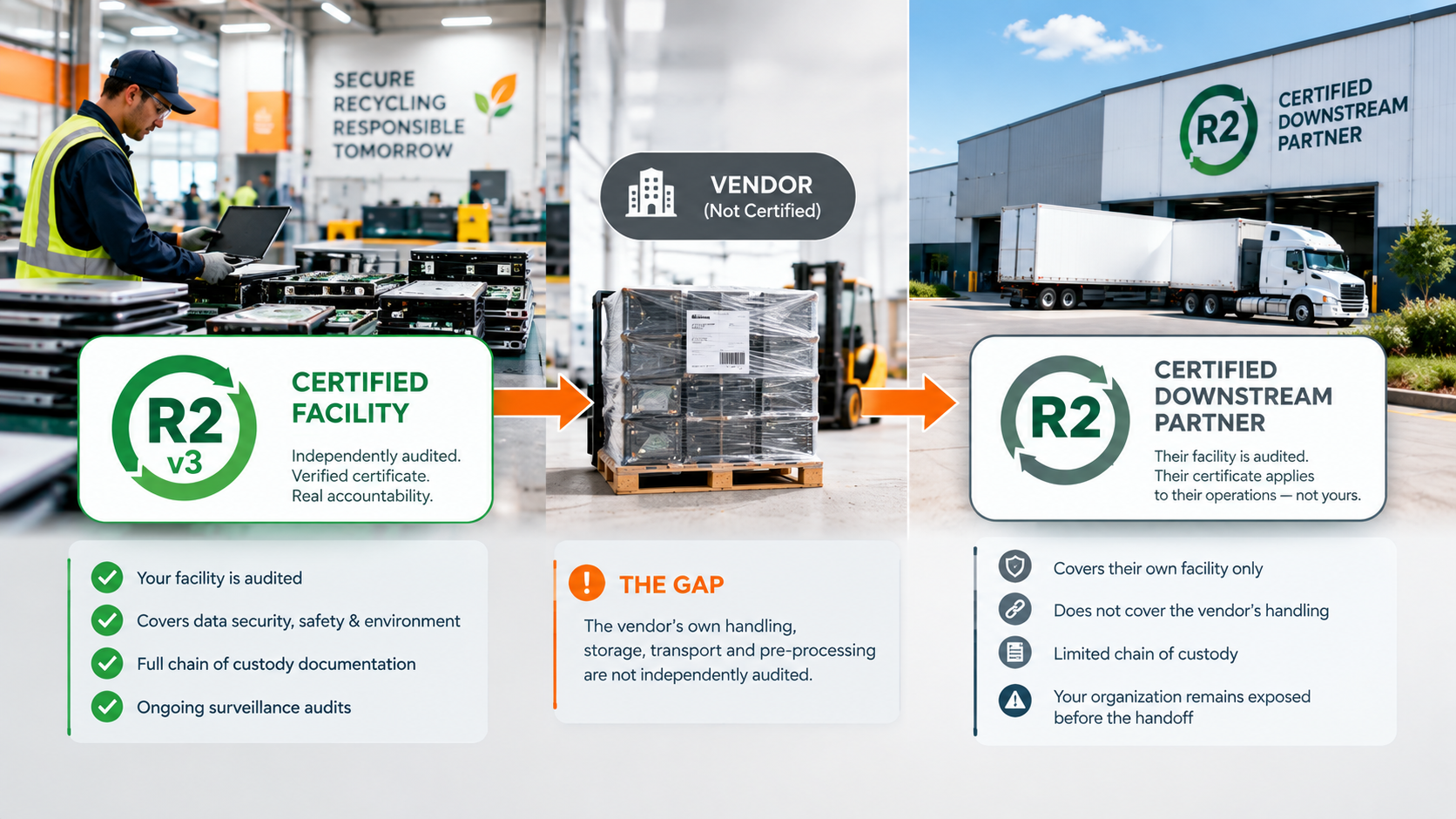
R2v3 certified means a facility passed its own independent audit against the R2v3 standard and holds a certificate with a verifiable number. R2-partnered, or R2-affiliated, usually means the vendor sends equipment to a certified downstream processor but has not been audited itself. Both phrases sound reassuring. Only one of them means the company handling your equipment was actually inspected.
This distinction rarely comes up until something goes wrong, a data breach, a compliance audit, or an environmental violation traced back through the supply chain. By then, it is too late to ask who was really accountable.
Quick Answer
R2v3 certified means the vendor’s own facility was independently audited and holds a certificate. R2-partnered means the vendor relies on someone else’s certification, with no independent audit of their own operations.
What R2v3 Certification Actually Means
R2v3 is the current version of the Responsible Recycling standard, developed and maintained by Sustainable Electronics Recycling International, known as SERI. It covers data security, worker health and safety, and environmental responsibility for facilities that handle used electronics.
To become certified, a facility must pass an audit conducted by an accredited, independent certification body, not by SERI itself and not by the facility. That certification body must hold accreditation from the ANSI National Accreditation Board, commonly called ANAB. This layered structure exists so that no company can simply declare itself certified.
The certification covers two categories of requirements:
- Core Requirements. These apply to every certified facility regardless of what services it offers, covering environmental health and safety, legal compliance, and a documented management system.
- Process Requirements. These apply based on the specific services the facility performs, such as data sanitization, equipment testing and repair, or materials recovery. A facility only needs to meet the process requirements for the services it actually provides.
Certification is not a one-time event. It runs on a three-year cycle. The first year involves a full examination of the facility’s processes, documentation, and procedures. Years two and three involve surveillance audits that review a sample, typically 60 to 65 percent, of those same processes. The specific sample is not disclosed to the facility in advance.
What “R2-Partnered” or “R2-Affiliated” Actually Means
“R2-partnered” is not an official R2v3 term. It is marketing language some vendors use to associate themselves with the certification without holding it. In practice, it usually means one of two things.
The vendor uses a certified downstream processor.
The company you are dealing with collects, stores, or brokers your equipment, then ships it to a facility that is R2v3 certified for final processing. The certification applies to that downstream facility, not to the company you signed a contract with.
The vendor is in the process of becoming certified.
Some companies use “R2-partnered” to describe a facility that has started the certification process but has not yet passed an audit. This is a future state being marketed as a present one.
In both cases, the company handling your equipment first, including data-bearing drives, has not itself been independently audited. Whatever happens before your assets reach the certified downstream partner is not covered by that partner’s certificate.
Common Mistake
Assuming “R2-partnered” means the same level of oversight as “R2v3 certified” because both phrases contain the letters R2. They describe two very different levels of accountability.
Why This Difference Matters
The gap between these two terms is not academic. It changes who is actually accountable for what happens to your equipment.
Data Security.
If a vendor is not itself certified, its own handling of your drives before they reach a certified downstream partner has not been independently verified. That includes storage, transport, and any pre-processing steps.
Chain of Custody.
A certified facility has to document the chain of custody through its own operations as part of maintaining certification. A non-certified broker has no equivalent independent requirement.
Liability.
If equipment or data is mishandled at the broker stage, before it ever reaches the certified downstream facility, that downstream certificate does not cover it. Your organization is left trying to establish what happened at a link in the chain nobody audited.
Downstream Accountability.
R2v3 requires certified facilities to track and audit their own downstream vendors, a principle SERI calls tracking throughout. If your vendor is not certified, you are relying on their downstream partner’s audits of a chain that does not include the company you actually contracted with.
R2v3 Certified vs. R2-Partnered: Side-by-Side Comparison
| Feature | R2v3 Certified | R2-Partnered / R2-Affiliated |
| Independently audited | Yes, by an ANAB-accredited certification body | No, the vendor itself is not audited |
| Verifiable certificate number | Yes, checkable on the SERI registry | No certificate to check for this vendor |
| Data handling covered by audit | Yes, if certified for data sanitization | Only once equipment reaches the downstream partner |
| Chain of custody documentation required | Yes, as part of maintaining certification | Not independently required |
| Accountability for pre-shipment handling | Falls under the vendor’s own certification | Unverified, outside the downstream certificate’s scope |
How to Verify an R2v3 Certificate in Three Steps
Do not take a badge on a website at face value. Verifying takes a few minutes.
- Ask for the certificate number. A genuinely certified facility can provide this immediately, along with the name of the certification body that issued it.
- Check the SERI R2 Certified Facility Registry. SERI maintains a searchable, public database of every currently certified facility. Search by company name or certificate number to confirm the certification is active, not expired.
- Confirm which process requirements the facility is certified for. A facility can be R2v3 certified for materials recovery without being certified for data sanitization. Ask specifically whether their data destruction process falls under their certified scope.
Pro Tip
If a vendor cannot produce a certificate number within the same conversation, that is itself useful information. A genuinely certified facility treats that number as a routine, expected question.
Questions to Ask a Vendor About Their R2 Status
- Is your own facility R2v3 certified, or do you use a certified downstream partner?
- What is your certificate number, and who is the accredited certification body?
- Is data sanitization included in your certified scope, or handled by someone else?
- Who handles my equipment between pickup and final processing, and are they certified too?
- Can you provide chain-of-custody documentation covering every stage, not just the final one?
Industry-Specific Stakes
- Healthcare organizations retiring devices that held protected health information need documented accountability at every handling stage, not just the final disposition step.
- Financial institutions typically face vendor due diligence requirements that expect a primary vendor’s own certification, not a downstream partner’s.
- Manufacturers and logistics companies with proprietary data on retired systems carry the same exposure if a broker mishandles equipment before it reaches a certified processor.
- Schools and nonprofits working with limited compliance staff benefit most from a single directly certified vendor, since it removes the need to separately vet a broker and its downstream partner.
- Government contractors often must document vendor certification status directly, since federal purchasing guidance recognizes R2 and RIOS certification specifically.
Common Mistakes Buyers Make When Evaluating Certification Claims
- Trusting a certification badge on a website without asking for the certificate number
- Assuming “R2 certified” and “R2-partnered” are interchangeable marketing terms
- Not checking whether data sanitization falls within the vendor’s certified scope
- Skipping the SERI registry check because the vendor “seems established”
- Failing to ask who physically handles equipment before it reaches a certified downstream partner
FAQs
What does R2v3 certified mean?
It means an ANAB-accredited certification body independently audited the facility against the R2v3 standard and issued a verifiable certificate.
What does R2-partnered mean?
It usually means the vendor is not certified itself but ships equipment to a certified downstream facility for processing.
How do I verify an R2v3 certificate?
Ask for the certificate number and confirm it on the SERI R2 Certified Facility Registry.
Is R2-partnered a real certification?
No. It is not an official R2v3 designation, only marketing language some vendors use.
Does R2v3 certification cover data destruction automatically?
No. A facility must specifically hold certification for data sanitization as one of its process requirements.
Why does this distinction matter for my business?
Because accountability for your equipment’s handling before it reaches a certified partner is not covered by that partner’s certificate.
Conclusion
R2v3 certified and R2-partnered describe two very different levels of independent verification. One means an accredited third party audited the facility itself. The other often means the company you are contracting with has never been audited at all. The only way to know which one you are actually working with is to ask for a certificate number and check it.
Minnesota Computers holds its own audited R2v3 and RIOS certification, verified by an ANAB-accredited certification body, rather than relying on a downstream partner’s credentials. The certificate number is available on request and can be cross-checked directly against the SERI registry.
Pro Tip
Before you sign with any ITAD vendor, ask for their certificate number. Contact Minnesota Computers to verify our R2v3 and RIOS certification and get a written recovery estimate for your retired equipment.
Relevant Blogs
 Certifications & Trust11 June 2026
Building Compliance Trust in Enterprise ITAD, Powered by Minnesota Computers
Zero landfill is becoming a defining requirement in enterprise ITAD evaluations, but the term means different thing...
Read More Certifications & Trust25 May 2026
Minnesota Computers: R2v3 and RIOS Certified ITAD Operations
ITAD has moved out of operations and into the audit conversation. This post walks through how R2v3 and RIOS certifi...
Read More Certifications & Trust20 May 2026
The Hidden Compliance Gaps Putting Enterprise IT Teams at Risk in 2026
Most enterprise ITAD compliance failures share the same root cause: documentation gaps that nobody notices until th...
Read More Certifications & Trust14 April 2026
Why Enterprises Are Choosing Certified Refurbished IT Infrastructure in 2026
Refurbished IT has moved from budget workaround to strategic procurement decision. This post examines why enterpris...
Read More